
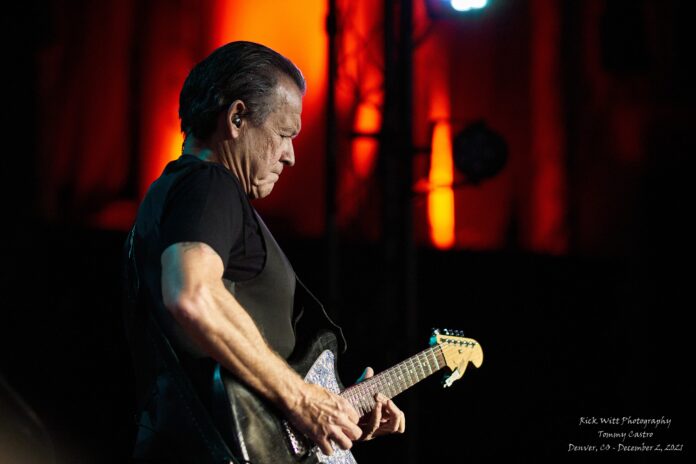
When Tommy Castro returns to Denver’s Oriental Theater on November 17, I’ll be heading back to the venue where I first covered him as a professional concert photographer and reviewer. That assignment is an easy one to remember—not just because it was my first, but because of what happened onstage that night.
Castro was losing his voice as the show went on, and bassist Randy McDonald stepped in on lead vocals. When Castro returned after the second set, it was to apologize rather than play an encore. What stayed with me was how much it seemed to bother him that he couldn’t finish the show the way he wanted to. I left with the impression that giving the people in that room a good night of music mattered to him—and that impression has stayed with me through the shows I’ve covered since.
Ahead of his return to Denver, I caught up with Castro to talk about what keeps the work interesting after so many years of recording and touring. We started with the live shows: keeping the set fresh, finding room for old favorites alongside newer songs, and playing for an audience that includes both longtime followers and people hearing him for the first time.
From there, the conversation ranged from his long partnership with McDonald to the very different approaches behind A Bluesman Came to Town and Closer to the Bone. Castro also shared the beginnings of another recording project, one that grew out of writing songs with his nephew, Mark Gilbert. There’s plenty here about making records, but also about the people and experiences that give him reasons to keep making them.
We spoke on the morning before he was due to leave for the Legendary Rhythm & Blues Cruise, with yet another tour to follow. It was an early start for a musician accustomed to late nights, and our conversation began with Castro still clearing away the morning fog.

Note: In the transcript below, parenthetical notes describe the setting or provide background; they are not part of my questions, or Castro’s spoken responses.
Rick: Good morning, Tommy. How you doing?
Tommy: Well, I’m going through the process of clearing out the fog. It’s always taken me a little while to wake up in the morning, but the older I get, the longer it takes.
Rick: I was wondering about that when we set this up. I thought this might be kind of early in the morning for guys like you that are used to being out late doing shows.
Tommy: Yeah. But you know, I’m heading out on the blues cruise tomorrow, and after that we go on tour, so that means this is a busy day. So I had to get an early start. It’s all good, man. We’re coming back to Denver!
Rick: Yeah, I was surprised to see that. I mean, you guys were just here in March, but we’re really excited to have you coming back so soon.
Tommy: Well, we kind of have a new strategy for Colorado. We don’t ever want to play Fort Collins and Denver in the same run because they will draw a lot of the same people. But yeah, we have this run of dates with GA-20 through the Southwest. Our first stop will be Albuquerque, then we wind up through Texas and then up into Colorado, Utah and Idaho.
Rick: I didn’t know GA-20 was opening for you. Man, they’re great. I’ve seen and covered them several times. That’s very exciting.
Tommy: Yeah, I like what they’re doing, man. I think it’s a good matchup because they’re more traditional than we are, overall. Although I’m pretty steeped in traditional blues, but my own sort of brand of it. My traditional blues goes more to Buddy Guy and greasy stuff like that. Not so much real slick, heavy guitar chops stuff. A lot of the traditional blues bands these days are harmonica-led bands. You know, you’ve got Rick Estrin who’s a little more traditional, and Mark Hummel. And then there’s traditional guys fronting bands playing electric blues, like Nick Moss. He’s kind of gone back to his meat and potatoes Chicago style blues. We do some traditional stuff, but it has to be of a certain kind, you know. You never really know what you’re going to get from us on any given night, song wise. We have so many songs now, and there’s a lot of pretty good ones, and we try to keep some of the old ones alive, while still playing stuff from our more recent albums. We’re getting to be like Warren Haynes or Luther Allison, where we need to play like three hours to get in all the stuff we want.
Rick: Oh, I agree with you, and I don’t think your audiences would be opposed to that. You get to a point where the catalog is so deep that no matter what you do, you’re going to be leaving out songs that everyone wants to hear.
Tommy: Yeah, I guess it’s a good problem.
Rick: It is indeed a good problem to have. And I guess that’s a good segue to what I would like to start with, which is the longevity of your career. You’ve been doing this for a long time, and I’ve covered your shows for quite a while. I’ve been consistently impressed with the quality and passion of your live shows. How do you manage to avoid burnout when you’re touring as much as you do, and how do you keep the music fresh for your audiences night after night?
Tommy: I think for me, it really comes down to the fact that this is something I care about a lot. And we try not to bore our audiences with the same show every time. The cool part, the really fun part, and artistically the most fulfilling part is creating new music. That gives us material so we can keep the show fresh. But you know, I’m not sure if that’s worked more for me or against me. If I had to guess, I would say it’s probably worked against me. My records, from one release to the next, are quite a bit different. Closer to the Bone and The Devil You Know are very different kinds of records. And you know what, I’ve got another very different one coming.

Rick: Yeah, the word on the street is that you have another project coming out soon. I’d love to hear more about that in just a bit. But I know it hasn’t been formally announced, so I don’t want to put you on the spot. You’re probably under something of a gag order. But we’ll see if we can talk about that a little bit.
Tommy: Oh no, we can talk about that. It’s very close to being announced, anyway.
Rick: That’s great. But before we get to that, I want to follow up on something you said at the beginning of your response to the last question. You said that it comes down to the fact that it’s something you care about. You know, the first show I covered officially as a professional journalist was your show at the Oriental Theater in December of 2021…
Tommy: And I couldn’t sing!
Rick: You got it, brother. You got it. I remember that show for so many reasons – mostly because I was scared to death. You know, I’m standing right there next to the stage, and you come out, and I’m thinking, “What am I doing here?” But yeah, you were starting to get sick, and your voice was getting worse as the night went on. At one point, Randy (McDonald) took over lead vocals. You guys had done two sets that night, and you finished up the second set. Everybody was waiting for you to come out for an encore. Instead, you came out and apologized to the crowd, saying, “Look, my voice is shot. I just can’t do it. I’m sorry.” And I want to read to you what I wrote in my review. I wrote, “It was difficult to tell what pained him more – the physical pain of his throat or the disappointment of not being able to wrap up the show the way he wanted to.” As I was walking out of the theater, I remember thinking that this is a guy who really cares about the people who come out to see him play and really cares about putting on a show that they’ll be happy with.
Tommy: Yeah, well, you see… we only get to Denver maybe once a year. We’ve probably even missed a year once in a while. And we have a mix of people that have been following us for 30 years, and there’s always new people in the house. The people that have been following us for 30 years have seen some good shows, and they’ve probably seen some not great shows, you know. But they know what we’re about. So if I’m having an off night, well, they’re very forgiving and supportive, and they’d all wish me well and still be happy that they came to the show and supported it. That’s the kind of relationship I feel like I have with my audience. But there’s always going to be new people in the house, and I don’t want the first time somebody comes to see me to be a night when I’m not able to sing. I’ve always felt like I was a better singer than I am a guitar player. I’m a strong blues guitar player, but in this day and age, when it comes to guitar skills and chops there’s so many great players out there. I don’t even try to compete with all of that. I have a certain vocal style and ability, and I play a good enough guitar to make all of that work. So when my voice is gone, I feel like the biggest part of my show is gone. People don’t necessarily come to see me play guitar, but they do come out to hear my songs, hear me play guitar, and sing. When you put that all together, I’m a strong performer. But if you take the voice out of it, I’m just another blues guy with a guitar around his neck. Now, I don’t know if that’s all true. I tend to be more critical of myself, which is what people tell me. But man, thank God that doesn’t happen very often. That was when COVID was still really around, so I was pretty sure I had contracted COVID, and I had to cancel the next night in Colorado Springs, which is always one of our big shows in Colorado. It’s a big room, and we’ve worked Colorado Springs all these years and developed a nice crowd there. And there was no way I was going to even try. I mean, I just couldn’t at that point. I could barely talk, let alone get any notes out. It sounded like if Howlin’ Wolf had a bad cold and couldn’t sing. (Laughing)

Rick: Ouch! Yeah, I remember that it made my throat hurt while listening to you try to talk. And I remember you having to cancel the show in the Springs because I was supposed to go to that show as well. But like you said, fortunately things like that don’t happen that often. I’ve had the good fortune to cover a number of your shows since then, and one of the things that’s always stood out to me is that you guys seem to be having so much fun on stage. There’s an obvious chemistry between all of you, and especially between you and Randy. Talk to me a little bit about your relationship with him. How important has it been to have someone like him be your wingman for all these years?
Tommy: (Tommy pauses briefly before answering. His voice is quiet and his words measured, with a hint of emotion as he begins talking about Randy.) Yeah, that’s a… boy. I don’t even know where to start. You know, when we started the band, we’re in our 30s and we’re playing around in North Beach, and there’s all this energy. In the blues clubs in San Francisco at that time, it was like the next best thing to being in Chicago, with all the great blues people playing the small clubs there. I mean, they still do, but that was a great era, you know, in San Francisco in the ’90s. There was a serious blues audience there at that time, people going to all the shows at places like the Fillmore and Slims and all the little, tiny bars. At that time we were just at the bar level, but we eventually worked our way up to Slims, and then we worked our way up to the Fillmore before we hit the road and became more of a national act. So we’re playing these little joints around San Francisco. We had met in a band called the Dynatones, and I spent a couple years there. Randy left the band before me, and I was really bummed about that because I really liked him, and I thought it was a big loss for the band. But we kept going for a little while longer, and then I decided it was time for me to start my own band. And of course, I asked Randy if he was interested in being the bass player. And then we found a really cool drummer in town – Shad Harris – who was on our first couple of albums. We figured we needed to be a four-piece band, and we didn’t know if we wanted the fourth person to be a harmonica, keyboard, or even a saxophone player. The reason we even thought of saxophone is because Johnny Nitro and the Doorslammers had that lineup. They were a four piece band with a harmonica, and at about the time we were putting our band together, Nitro added a saxophone player named Tony Perez. That four-piece with the saxophone was cool because there’s a lot of different material you can do with a horn that you can’t do with a harmonica.
Sorry, long story. I’ll try to speed this up a bit. So anyway, Randy and I go way back. When I asked if he wanted to join my greasy little bar band in San Francisco, we had high hopes for where we might go from there. And he joined, and we got Keith Crossan on saxophone, which was the magic combination for a while there. We got signed to Blind Pig (Records), and we got signed to an agency. You have to have both of those things if you’re going to leave town. You need a record label to get an agent to book you, and you need an agent to book you if you’re going to get a record label interested. It’s kind of a catch 22. But somehow we pulled it off, and this is where this story really kicks in, because now we have to start planning for travel. We’ve got a new record out, and we’re going on the road, and I’m like, this (travel planning) is not a good job for me. But I’m the band leader, so I’m trying to do it. And Randy kept on giving me advice, asking me if I did this, and if I had done that, and if I tried this, if I tried that. So I finally went, “I think this is a job for you. What if I pay you more than everybody else, and you can handle this for me?” And he was relieved because he likes to have it done right, you know. So besides being so important to our sound as a bassist and entertainer – you know, his main job – he became the band’s road manager.
We’ve had an amazing, long run of a relationship, you know. I’ve been in recovery for the last 23 years, which means that Randy and I were on the road together for years before I got sober. He had to put up with a lot. It’s just the nature of that disease. But you know, we kept it together. I was rarely on stage noticeably buzzed or anything like that. That was something I would do after hours, but it was still a lot. It made it really hard for him. We went through a lot. We’re like a family. He’s like a brother to me. He’s my daughter’s godfather.
And we’re still doing it. We’re like a couple of brothers that don’t get along all the time. We work closely together. It’s stressful work – hard work – and we get on each other’s nerves from time to time. But he’s totally got my back, like 100%. Whatever we’re trying to accomplish, he’s there, helping me get it done. I just heard from him today to remind me that I’ve got this interview. I’ve watched his kids grow up, and he watched mine. So I don’t know what I would do without Randy. You know, we did it for a few years without him (Randy temporarily left the band from 2007 to 2012), and we managed. But man, I was glad to get him back.

Rick: Thanks for sharing that with me, Tommy. I know what it’s like to have a decades long relationship with a friend like that, so I completely get where you’re coming from.
So I’m going to jump ahead a little bit because I want to be respectful of your time. I do want to talk about some of your music, and I want to start with A Bluesman Came to Town. That’s my personal favorite of all your albums. It’s just a magnificent album – one of those career-defining records.
Tommy: Thank you.
Rick: I also thought it took a lot of guts to do because concept albums like that just aren’t something people do much in this day and age, especially in the blues and blues rock worlds. How did you come to think about doing an album like that at that point in your career (the album was released in 2021)?
Tommy: So this was right after we were coming out of COVID, and I knew it was time for a new record. We had that live album (Killin’ It Live, released in 2019) that got us through that. We really needed something new in the works, and I was looking back at all my albums, all the years, all the different kinds of material, all the different kinds of records we’ve made, and I’m like, “What am I gonna do now?” And it was my partner at the time who just happened to ask if anybody had ever done a blues opera. You know, like a rock opera. And I thought, “Hmm, bold idea,” and I ran with it.
So I called Bruce Iglauer (Founder and CEO of Alligator Records). Said I’ve got this idea… the story of a bluesman, based on this whole idea of a hero’s journey. I had recently read The Alchemist, and if you’re familiar with that book, and you listen to the story of A Bluesman Came to Town, you’ll see some similarities. So I told Bruce about the idea, and I really thought he was going to go, “Are you out of your mind”? But he didn’t. He did like the idea, but he didn’t like the idea of calling it a blues opera. So okay, I don’t care what we call it, but this is the idea. Each song is going to be part of a story, and I started working on that. I made an outline of that story, and then I called and got together with Tom Hambridge (Grammy-winning record producer, songwriter, drummer, and singer).
That was another big piece of the puzzle. I had known Tom for many years, but we had never worked together. We’d talked about making a record together for many years, but had never done it. But I’m thinking now might be the time to make that Tom Hambridge record. I knew he would be the right guy to help me pull this together because he’s a great songwriter and a really great producer. So I called Tom and we worked out a plan. I gave him the outline. Kid grows up out in the country with his life all planned out for him. He’s gonna marry his high school sweetheart. He’s gonna take over the family farm. It’s a no brainer. But late at night he lays there thinking that he wants to do just about anything else but that. He wants to go places and do things. And then he hears about a juke joint somewhere out of town, and he hears this blues guitar, and that gives him the idea that that’s what he wants to do. And then, just like it is in a hero’s journey, there’s always a wise old man that guides the young man on his journey. And in this story it’s an old blues guy in town that played guitar and was teaching him to play. He said, “Son, get out there and find your fortune. Get out there and do something with this music.”
And as I was running it by Tom, he took each thing that I said and worked with it. I said a bluesman came to town, and that became a song title. He wrote it down – “A Bluesman Came To Town.” And I said, then he leaves home, and his family is telling him they don’t want him to go. Tom writes, “Child, Don’t Go.” Another song title, and we wrote that song together. Anyway, it went on like that.
But I’ve got to tell you, we got really lucky with the songs, because we didn’t write them in any order. I threw the ideas out, and he jotted them down, but when we were writing the songs we weren’t thinking about how they would fit together on the record. So look… when you put an album together, you have to sequence the different kinds of songs, so it has a beginning, middle and end, and it has an overall flow. You can have fast songs, slow songs, mid-tempo songs, different kinds of grooves, and the right sequencing is important. Even without a story, it’s already a tricky thing to do, right? So now we have all of these songs, but how are we going to get those different songs mixed and sequenced in a way that tells the story, and also has all the elements of a good sequence of a record? That was the part we hadn’t really anticipated when we made our original plan. And it just sort of dawned on us… what if we have three slow songs in a row, or what if all the fast ones are in a row? But it didn’t fall out that way. It actually came out perfect.

Rick: I would certainly agree with you on that. It’s a go-to record for me. If I’m not really sure what I want to listen to, that’s what I put on. And I like to listen to the whole thing in a single sitting. So from the perspective of a fan, thank you for such an incredible album.
Moving forward, let’s talk about your most recent release, Closer to the Bone. Another gutsy call on your part, but completely different from Bluesman. You’ve described it as a record you always wanted to make: a kind of stripped-down, old-school blues record with a mix of new material and some lesser-known covers. So again, where did the idea for this kind of record come from, and why did you choose covers that wouldn’t be the first songs to come to mind for most blues fans?
Tommy: Well, I just really kind of wanted to let people in, you know? I mean, being a contemporary guy, people tend to want to call a guy like me rock blues. You see a white guy playing blues guitar, and it’s almost automatic that it’s rock blues. But I don’t think of my music as rock blues. I just think of it as blues. I have elements of rock and soul, traditional blues, and Americana, and all those things come together. Some of my songs are really hard to even put in a category. So on this record, I wanted to let people who lean more to traditional blues know that I love that stuff too. And not only that, but I love to play that stuff, and I have been listening to that stuff, and it has influenced my music in a big way. I wanted to give a little background on me and my taste in blues. So I did the Wynonie Harris tune (“Bloodshot Eyes”). Ray Charles has been a big influence on me. Buddy Guy. I didn’t do a Buddy Guy song, but I did a song in the Buddy style with “Crazy Woman Blues.” And to help me with all this I consulted with Bruce Iglauer, and another guy named Dick Sherman. Dick Sherman is like a blues historian and a record producer from Chicago. Did some Delmark releases. He’s got a long history, and those two guys are encyclopedias of blues music, and they have it all on vinyl in their houses. They still have all those records. So I told them I was looking for some interesting stuff off the beaten path because I wanted to make a traditional blues record, but I didn’t want to do the obvious songs. And so I picked a few things that I knew about and wanted to do, and they gave me some things to look at.
And then of course the other big element of that album was Kid Anderson (Christoffer “Kid” Anderson, celebrated blues guitarist, multi?instrumentalist, songwriter, arranger, and record producer). What a talent and what a fun guy to work with! I mean, that’s like going to Disneyland for a guy like me. Going over to Kid Anderson’s place, I mean, it’s an incredible scene, and Kid’s energy and talent for whatever needs to be done in the studio, whether technical or musical, he can do it himself, and so you don’t need a lot of people around. You got the band and you got Chris, and you go in there and you cut, and maybe you need an idea. You need to figure out how you’re going to get from here to there. Bam! He’s got an idea just like that. And if Randy and the band have already gone home, and we need to fix something on the bass on a song, he can do it. One song we completely recreated right there in the studio, and that song, “Can’t Catch A Break” won the award for Song of the Year (at the 2025 Blues Foundation’s Blues Music Awards). I had a completely different groove for that, and then we realized that it was too much like one of the other songs on the album. So we came up with a whole new groove for that, and Kid played bass, and we called June Core, who was in the neighborhood, to come over and play drums, and the three of us recorded that song right there that day.
So it was a really fun record to make, and I’ve been having a blast going around playing some of the songs from that album. You know, there’s a couple of good slide tunes on there, and I got to pay tribute to some of my local San Francisco Bay Area guitar heroes like Ron Thompson, Johnny Nitro, and Chris Cain. And I had some other local Bay Area musicians play on it. Jim Pugh played on it. Chris Cain played piano of all things because I’ve heard him play piano like Ray Charles.
Rick: That’s amazing that you completely reworked “Can’t Catch a Break” and it goes on to win Song of the Year.
Tommy: I know. We did it within an hour or something like that. We knew we needed a whole new groove, and that turned out to be right. People really like that one. I get a great response every time we do it. Who knew?

Rick: Ha! Who knew, indeed. Okay, we’re running really late, so what can you tell me about the new record coming out in January?
Tommy: Okay, so I’m going to try to say this real quick (sly chuckle). About a year and a half ago, a kid I grew up with, my nephew, who’s only like three and a half years younger than me, so he’s more like a little brother. We used to write songs together, and we played in bands together when we were young. Anyway, he came down with a case of lung cancer, stage four.
Rick: Oh, damn man, I’m so sorry.
Tommy: Yeah, I know, right. Thanks. Anyway, our whole family started to rally around and try to support him, and the only thing I could think to do to help was say to him, “Hey, we should write a song, you know, like we used to. I think it’d be good for you to take your mind off of things and maybe put some of your feelings into a song.” So we agreed to get together and write. And so he’s going to get treatments, and we started writing songs, and we just kept writing. And he kept getting treatments. And we did that for about a year, and we’ve got a dozen songs, and he’s cancer free.
Rick: Oh, wow!
Tommy: So I called Joe Bonamassa, and told him I was looking for a new producer for this next album. He’s a busy guy, but I know he’s worked with some of my friends, and would he consider doing an album with me? We went into a studio in L.A., and I worked with him and Josh (Smith), and it was one of the best experiences I’ve ever had in the studio. Those guys are really, really good dudes and very talented. And they have a process that they’ve created for making records over the last several years. They’ve been working with other artists, and they’ve got it down to a science. So it’s almost as much a Joe Bonamassa and Josh Smith record as it is a Tommy Castro record, and of course my nephew, Mark Gilbert, is in on all the songs.
It’s going to be different, though. The important thing to know about this album is that I was writing songs to help my nephew get through his cancer treatments. We’re just writing songs. We weren’t trying to write blues songs. We weren’t trying to write any specific kind of song, and we weren’t trying to make it too heavy and too personal. We didn’t want it to be about his condition and his illness or any of that. We just wanted to write songs because we like to. We’re songwriters and we love to write. And we hadn’t written together in a while, and we were really enjoying the time together. And the songs were just fun to write. And I realized after we had about six or seven that maybe we had an album in the works. He was getting good news every time he went to the doc, and the songs were coming together. And I just thought this has got to be a record, you know.
Rick: Tommy, I’m completely speechless. What a story that is! So amazing and so powerful. I am so looking forward to January when I can listen to the whole thing.
And now, my friend, I’m going to let you get on with your busy day. Thank you for spending so much time with me this morning. I know you’re preparing to head out on the cruise, so good luck with that. And then we’ll see you in Denver, at the Oriental, in less than three weeks.
Tommy: Oh, absolutely, man! And before I go I just want to tip my hat to the audiences in Denver. In Colorado in general. You guys are one of the best music audiences and music lover states. There’s just something about the crowds in Colorado, the way they embrace live music in general. They really love the roots music, and we love playing for you guys. And at the Oriental, you could stand, dance, sit, whatever you want. You got plenty of room for all of that. It’s not an either/or. You’ve got the best of both worlds there. So, I look forward to seeing everybody out there. And thanks to you for having me on. We’ll see you soon, and we’ll have ourselves a time.

For all the ground we covered, I kept coming back to something Castro said early in our conversation: this is something he cares about. The records may take different turns, but he’s still finding songs he wants to write and people he wants to make music with. Having more songs than he can fit into a set seems like a pretty good reason to get back on the road.
That first night at the Oriental didn’t end the way he wanted it to, but it gave me a reason to keep coming back. On November 17, I’ll be there again, cameras in hand, curious to hear which songs make the cut. Castro already has a plan for the rest of it: we’ll have ourselves a time.
Tickets to Tommy Castro & The Painkillers’ November 17 show at Denver’s Oriental Theater are available through the venue’s website at Oriental Theater – Tommy Castro, or Hold My Ticket at Hold My Ticket – Tommy Castro. Either link will ultimately take you to the same place.
My heartfelt thanks to Tommy Castro for his time, enthusiasm, humor, and candor. Interviewing him has been on my bucket list since that December night nearly five years ago. They warn against meeting your heroes for fear of disappointment. This meeting proved otherwise—by a mile.
Interview, story and photos by Rick Witt www.rickwittphotography.com