

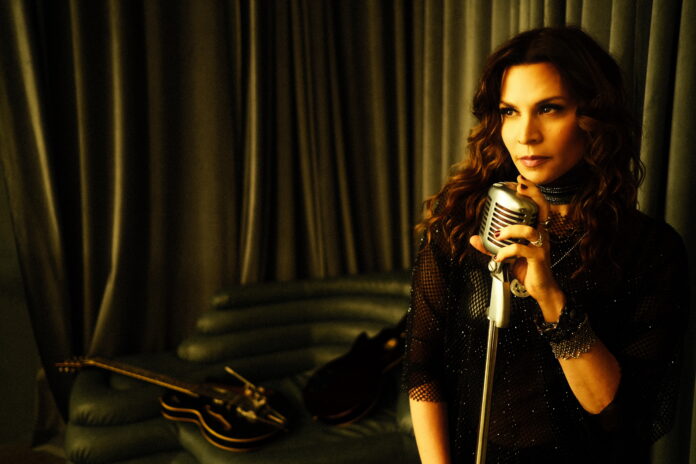
Colorado Front Range blues-rock fans, it is my pleasure to introduce an exceptional artist you may not yet know. Even if her name is familiar, you may not realize she has a brand-new album arriving this Friday. If you already knew both, I tip my hat to you—you are truly a world-class blues-rock fan worthy of recognition.
That artist is Ali Handal, whose fifth album, Slow Burn, arrives this Friday.
Handal is the kind of artist who refuses to stay in one lane. A Los Angeles–based guitarist, singer, songwriter, and entrepreneur, she has built her career on the tension between muscular rock guitar and a more intimate, melodic side—moving comfortably from gritty riffs and expressive solos to vulnerable, acoustic-driven songwriting. Her playing is technically assured without losing sight of the song, while her voice can shift from raw and forceful to warm and disarming in a single phrase.
For listeners who know their blues-rock, Handal’s latest work offers a particularly compelling entry point. On Slow Burn, she purposefully turns up the heat on the bluesier elements of her sound: bold guitar tones, swaggering grooves, and a vocal delivery that carries both grit and emotional weight. It is a natural evolution for an artist whose influences range from classic rock to rootsier songwriting—and a reminder that softness and strength have never been opposites in Handal’s music.
Earlier this week, ahead of the release of Slow Burn, I spoke with Handal for about forty minutes via Zoom. Her compelling story deserves more time than this initial conversation allowed, and a follow-up is already under consideration—fingers crossed. For now, read on to meet an artist who, with any justice, will not remain unfamiliar for long.
************************************************************************
Rick: Hello Ali. Thank you so much for spending time with me today – I really appreciate it. It’s an exciting time for you, with a new record coming out in just a few days.
Ali: Yeah, it’s very exciting.
Rick: We’ll talk more about the new album a bit later in our conversation. I do have to preface the rest of the conversation by saying that I’m usually really, really good at putting together an outline for a conversation that will run about 30ish minutes. But as I’ve been working for the last week on the outline for your interview, I realize I’m totally doomed because the outline I’ve put together is more like three hours.
Ali: Oh my gosh! (Laughter)
Rick: Well, it’s just that you have such an interesting career, and there’s so many layers to it, so it’s been a challenge to try to figure out what to include and exclude. So we’re just going to dive into it, and see where it goes, okay? We might do a little bit of jumping around, but we’ll do the best that we can.
Let’s start with a little bit of backstory. I want to go back in time to that pivotal decision you made all those many years ago, when you were a student at UCLA studying psychology, with plans to go on to get your Ph.D. and enter into a career in counseling. My question for you really comes out of the fact that I have my own undergraduate degree in psychology, and any time I encounter ‘kindred spirits’ I like to ask them what led to their decision to go into psychology as a college major in the first place?
Ali: Well, I think it was because when my parents split up when I was 15, they immediately put me into therapy, and I found it really helpful. Looking back, I’m not sure I did much more than just cry and talk to this woman. But as a 15/16 year old, that’s what I needed. And to be fair, I was a double major at my first college. I was a music major and psych major. The only reason I didn’t stay a double major was because at that time UCLA would not allow students to double major in two subjects that were in different schools. School of Fine Arts and the School of Letters and Science. And I had been diagnosed with vocal nodules, so I just was like, you know what… I’m just gonna get my degree in Psychology. But what was kind of a bummer was at Occidental College, my first school, I was taking a lot of music classes, and once I switched to UCLA and decided I wanted to get my degree in Psychology, I really had to just knuckle down and basically only take what was required for that. Plus, I decided to do an Honors Program, which required more classes. So I really didn’t get to take any classes that were just fun or interesting to me, other than maybe Psychology and Criminal Psychology and Abnormal Psychology. I love all that stuff, but I didn’t get to take any of the other cool stuff in college that a lot of people get the opportunity to take. But now there’s YouTube, so you don’t need college. (Laughing) I can learn about anything and everything, and I do. My YouTube algorithm is so messed up.
 Rick: You mentioned your vocal nodules, which is another thing you and I have in common. Did you have to have surgery for them, or were you able to take care of them through rest?
Ali: I did not (have surgery). I rested, and I still have a vocal polyp, which fortunately doesn’t affect my singing or speaking abilities at all. I actually was at the ENT last week, and what they said was because my nodule was diagnosed in the ’90s, that most likely it might have actually been this polyp. The diagnostic tools they had back then were so much cruder than they are now. So I didn’t have to have surgery, but I stopped singing, which was sad. It was just really, really sad.
Rick: Well, I’m glad you didn’t have to have surgery, because it does impact both the sound and strength of your voice. So it’s good you didn’t have to go through that.
Let’s talk about your decision to scrap your plan in Psychology and instead pursue music as a career. You’ve had music in your blood since you were very young. So was the decision more of an epiphany where you woke up one morning with a “what was I thinking” thing going on, or was it something you struggled with over a period of time?
Ali: Oh, I struggled a lot with it. Yeah, because I was really good at school, you know. I was a straight A student. I got one B+ in college. I’d gotten straight A’s in high school. I mean, I know how to do school, right? It’s hard to go from something you really know how to do well to something you kind of suck at, you know. I’d always had vocal problems my whole life, and up until fairly recently, I was never the guitar player I wanted to be. I kind of sucked, and I knew it. I have very high standards, so I was intensely depressed and miserable.
But you know, I didn’t come here to study Psychology at UCLA. I moved to LA for college because Guns N’ Roses was here. Every guy I dated was a long haired guitar player. (Chuckles) Okay, I ended up marrying one too, but… And I didn’t want to just date that person – I wanted to be that person. I really wanted to be the person on stage, playing with reckless abandon and singing.
So it was a very, very tough decision, and it was not embraced happily by everyone, especially my dad. You know, my parents were terrified for me, and rightly so. It’s a horrible business decision. But I was raised to always value what’s in your heart, more than money, more than stability. I’ve sacrificed quite a lot of stability and money to follow my passion. And I’m really glad I did now. But it has taken me on a very weird journey that I could never have imagined.
 Rick: Well, I think it all worked out pretty well. Kudos to you for following your dream. I’m sure you would have made a terrific counselor, but selfishly, I’m grateful that you took the path you did because it resulted in your sharing your gift with the world. And for people like me, who aren’t remotely musically inclined, that is a priceless gift you’ve given to us.
Ali: Oh, thank you, Rick. That means a lot to me.
Rick: So let’s segue to your career and music, shall we? I first discovered you… it’s been at least a dozen years, maybe a little bit longer ago, when I heard your absolutely killer cover of “My Sharona.”
Ali: Ha! We’re doing that song at the album release party.
Rick: That song just rocked! And when I first heart it, my first thought was, why would anybody want to cover something as iconic as “My Sharona?” But as I listened I realized what a brilliant choice it was. So that was my introduction to you, and it led me to search out more music from you. I’ve listened to all your records, and in preparation for this interview, I went back and listened to all of them chronologically, including the new one, from an advanced copy your publicist provided me with. And as I listened to those with more of an academic type ear, it popped to me how many different musical styles were coming through.
Ali: (More laughing) That’s kind of always been my problem.
Rick: Well, is it a problem or is it just another part of your gift? Here’s what I hear… there’s the straightforward rock music, but then there’s this softer acoustic side that’s not just thrown in for an occasional change of pace. Then there’s this broader kind of pop/blues/funk palette thing going on in many of your songs. And I hear some touches of country rock, and then a more than healthy dose of blues-rock. Is that all fair and accurate?
Ali: Definitely, except for maybe the country. A lot of people say that because they hear it in the slide guitar, but that was never an influence I really liked or appreciated that much. But you’re absolutely right, and I always saw it as a weakness just because of the industry wanting an artist to be of a certain genre. But now I’m much happier and content to be an independent artist doing it on my own and not worrying about what the industry has to say. It has been a very, very, very, very long journey that I have only recently come to be fine with. I’m just going to do my own thing. It gives me so much freedom. Take, for instance, this show I’ve got coming up. We’re leaning hard into the funk. I love funk, you know, like Prince and Red Hot Chili Peppers and all that stuff, huge influence on me. In fact, after this show, my next kind of grand idea for developing my show further is to add horns and have a 30 or 40 minute funk set. I’ve also started writing a feminist protest record, which is going to be way more like Rage Against the Machine… kind of very heavy like. Guitar is always going to be a huge part of everything I do, whatever style it is, and I just feel like life is too short to pigeonhole yourself if you don’t want to be pigeonholed.
I mean, with the new record, I was very conscious to make it a blues-rock record. I added slide guitar into almost every song. I had released a song on Spotify, I think in 2020, and it had a lot of slide on it because that was the way the song was, and everybody called it a blues song. And I was like, okay. And I looked around and saw all of these other female guitar players being categorized as blues, even though some probably were and some maybe not. As it turns out, people who love female lead guitar players, lead singers, songwriters – they listen to a lot of blues. They love live music. You know, that’s just a thing. I feel like I’m really a rock artist, but this record is going to come out as a blues record because, as an independent artist, it’s a lot easier to have an impact in a smaller genre.
So I’m definitely leaning into all the genres that I love and I’m not worrying about it anymore. Music is music. I mean, there’s even a lot of heavy guitars in pop music. It’s all kind of a bogus, the whole genre thing. It’s just for convenience for the industry, and I really don’t care to help them out anymore. Not that I ever did. Not that they ever cared what I did.

Rick: (My turn to laugh, again) All that you just said is a prime example of why I have a three-hour interview outline for you. There’s just so much meat on them bones! The whole genre discussion – it comes up in almost every interview I do, and in most of the show reviews I write. Artists generally don’t care one bit where other people place them. It just doesn’t matter to them. What matters is making music that people want to hear.
Ali: My biggest influence, my favorite band (Led Zeppelin), had an acoustic record. They did whatever they wanted to because that’s what moved them, and that’s the type of artist I love and I want to be, and so that’s what I’m doing.
Rick: Speaking of acoustic albums, let’s talk about Breathing Underwater. It was your second album, and it followed a debut album that I would characterize as primarily a rock album, but with a lot of soft touches to it. But at its core it was a rock album. And here you are, following it up with this soft, acoustic album.
Ali: Yeah. That might not have been very smart.
Rick: Well, I don’t know if it was smart or not. It might have been brilliant. Personally I thought it was a very bold move for an artist trying to establish themselves and build an audience, because it might be confusing to people who had listened to the first album, liked it, and were looking forward to the next one. So my question for you is, what led you to do that at that time?
Ali: Well, I was ready to put a new record out , and that was just the kind of songs I had been writing. I had been touring solo acoustically, so I was writing everything on my acoustic guitar. Plus I’d also had a pretty bad heartbreak, so a lot of the songs I was writing, and that made it to the record, were about that. So I guess it was a confluence of all those things. Like I said, I was ready to put a record out, and I’m really glad I did. But I do think that if I had been on a record label, they would have pushed me to write more rock songs.
It might not have been the greatest business decision, but you know, I’ve got the songs now, and one of the future projects I have in mind involves them. I have this document with all these recording projects I want to do. And one of the things I want to do is to take some of the songs from that record and reimagine them as electric songs. I would love to do that, you know, to have like vintage synths and all kinds of crazy stuff. I feel like my voice is more naturally suited to the ballads. I don’t have a Robert Plant or Stephen Tyler kind of voice, but I am working on learning how to be better at that. So I’d love to try to reimagine a bunch of those songs in a different way.
 Rick: You won’t believe this, but my next question is about exactly that. Ali, you have a remarkable knack for anticipating and setting up my planned transitions—it’s almost as if we prepared this interview together. Anyway, I wanted to talk about a couple of songs from your catalog that you have already repurposed from an older record to a newer one. Specifically, I’m talking about “Shut Your Mouth”, which originally came out on Make Your Move and will be returning as “Shut Your Mouth And Do Something” on Slow Burn, and your cat homage “Indy”, from your debut album Dirty Little Secret, that came back as “I Love My Pussy.cat” on That’s What She Said. Those songs got me thinking about the nature of songwriting, and specifically this idea of when does a songwriter know that a song is finished? And as I thought about that, I began to wonder if “finished” is even a thing. And now you mention that you’re thinking about reimagining some of your softer songs as electric songs. So the question is, are songs ever finished?
Ali: So, that’s an interesting question, and I think there are different ways to look at it, depending on the song. For example, for the cat songs, I rewrote the lyrics completely, but I didn’t touch the music. I mean, obviously I re-recorded it, in a slightly different style. With “Shut Your Mouth And Do Something” it was same lyrics, but completely different music. I loved the lyrics on that one so much, and when I recorded it the first time I was happy with the music. But after a while, I felt like I would like a version of that song that fit better with the type of music I was playing now. At the time I was beginning to move away from straight rock, and the original version of that song was exactly that. For that song it was really a case of reproducing it.
So when I’m thinking about reimagining those softer songs as electric songs, I’m not going to be changing the songs themselves. There would be no rewriting at all. I would consider it rewriting if I was changing the lyrics or the chords or the melodies. But for these songs, I wouldn’t want to do that. I would just want to have a completely different production. So it’s kind of like a cover of my own song, you know.
Rick: I think that sounds like a fabulous idea. Sign me up… I would love to hear it.
Ali: And that’s really all I care about, is that people would want to hear it. You know, I’m getting ready for this album release show, where I’m playing songs from throughout my career. One of the songs we’re playing is “Slave to Ambition”, which is the first song from my first record, and is a song that was heavily influenced by the Chili Peppers. For a lot of those older songs, we had four or five guitars on them. For this show, we have one guitar player in the band. We have keys in this band, which I didn’t have on the first record. So for “Slave to Ambition”, we’re going to be rearranging it totally. Everything is fair game, nothing is sacred. And I like doing that.
You know, when I first started putting bands together many, many years ago, I was trying to completely recreate the record. That’s very hard, and I’m sure really annoying for the people you’ve brought into the band. You’re telling them to play the song exactly the same way that the bass player played it on the record, rather than leaning into the talents and natural abilities of the people you’ve chosen to play with, which is how I prefer to do it now.
 Rick: Well, and there’s also the fact that you have to be how you are in the moment, right?
Ali: (Emphatically) Yes! And I used to be so afraid of that. “So in control, so not rock and roll” is one of my lyrics, right? I’m such a control freak. It kind of goes back to what I was saying earlier about being so good at school. You go to school, and then you take the test, and then you move on to what’s next. But in music, who the hell knows how anything’s going to happen? You don’t know. I don’t know. No one can predict. How many people quite famously said no to the Beatles? (It has been reported that five British record companies passed on the Beatles before they were signed by Parlophone.)
Rick: I think that not knowing is part of the mystique. I go to a lot of concerts, and as a member of the audience, I don’t want to hear every song played exactly the way it was recorded. If I wanted to listen to the record, that’s what I would do.
Ali: But I did, though. I wanted to hear the guitar player play that exact solo. Or if it’s a really iconic melody, I wanted to hear it exactly like that.
Rick: Yeah, but you hit it on the head when you said “iconic”. For example, the opening guitar on “Sweet Child O’ Mine” is so iconic that you have to hear it played that way. If you don’t, everything from that point is off kilter. But that still leaves room for people to be spontaneous and to branch off and do unexpected things. For me at least, part of the joy of live music is seeing and hearing something beyond what I could experience if I went home and put on the record. As long as it doesn’t betray the spirit of the original song, but builds upon it.
Ali: Yeah, you’re right about that. You want to be there for something that’s only happening here and now.
Rick: So let’s talk about the new record, okay? As I mentioned, I got an advance copy of it, and I’ve listened to it several times. And I’ve got to say, I think this is your best album to date. A big part of that, of course, is that I absolutely see this as a blues-rock record, which is the space I spend most of my time in. I had planned to ask you if there was a particular musical or emotional direction that you were going for, but you already answered that by saying that you were deliberately going for more of a blues-rock vibe. I’m glad you said that, because it means my instincts were true.
Ali: Yep, that’s what I was going for, and I’m glad it came across.
Rick: There are two really high-profile covers on the album. You’ve got “Come Together” by the Beatles and “Walk This Way” by Aerosmith. How or why did you decide on those particular songs to include on the record?
Ali: “Come Together” is a song I’ve always loved, and I love playing it. Whenever I do a cover, I always change the vibe and usually the genre, the arrangement, the feel. I love to change the feel, you know rhythmically. And for both of those covers, the bass we’re using is not an electric bass; it’s an acoustic, you know, stand-up bass, and it’s very sultry, groovy, and slowed down. I just love performing both of those songs that way, and including a lot of close harmonies, especially on “Come Together”. As far as “Walk This Way”, I’ve been in an Aerosmith tribute band for quite a while…
Rick: (Shamelessly interrupting) Oh, I’m very aware. And I wasn’t planning on letting you get away without talking about RagDolls (the tribute band Ali referred to).
At this point in the interview, we had to take a quick pause for Ali to send a text message to her publicist to let him know we were running a bit long in our conversation. She had another interview scheduled right behind mine, and was obviously going to be a few minutes late dialing into it.
Rick: I want to be respectful of your time, and the time of the folks next in your interview schedule, so let’s see if we can’t wrap this up in short order, okay?
Ali: Thanks. I appreciate that.

Rick: Do you have plans for any touring to support the new record?
Ali: No plans right now. If I manage to get some kind of angel investor or corporate sponsor, yes, but it’s expensive to do otherwise. With gas and everything else right now, it doesn’t look that feasible. But what I am doing, I have this Patreon kind of thing called Backstage with Ally, which is a VIP Members Club you can sign up for on my website. I’m really ramping that up. In fact, I was just talking to my team about this today. We’re going to start live streaming… you know, shows with the band, in nice rehearsal spaces where the sound is great. I can actually afford to do that and share the music with people. I really do love playing live, but I’m at the point in my career where I really need to make sure it’s financially feasible so that I can continue to record and put out music. I guess I’m trying to finally be responsible and aware of that kind of thing. But I’m very open to possibilities. Who knows what could happen?
Rick: No, I’ve got you. And I know Denver’s a ways for you to come, but if there’s any way I could twist your arm, we’d absolutely love to have you here.
So let’s take this thing into the homestretch, shall we?
Ali: That’s probably a good idea.
Rick: I really did want to dive a bit into your involvement with RagDolls, but maybe we can do that some other time. Aerosmith is my all-time favorite band from the classic rock era, so my interest comes from a place of genuine love. But again, perhaps at another time.
Ali: I love it. We’ll talk another time for sure.
Rick: So we’ll finish with this, which I will acknowledge is not one of those “quick to answer” types of questions. It’s been more than a quarter century since your first record. That’s obviously a long time. A lot has happened. The evolution in the music industry over the last 25 years is unbelievable. And your life, you’ve had a lot of ups, you’ve had a lot of downs, you’ve had a lot of things happen to you that we didn’t get into. Given all that, how has all that has happened in that span of time changed the way you think about time, your ambition, and how you view what constitutes success?
Ali: Oh my gosh, that could be a whole other interview.
Rick: Like I told you… three hours.
Ali: I spend so much time pondering those questions because those are the most important questions in my life. I’ve always been very conscious of the passing of time, even before I started my music career, but especially since then. I released my first record when I was 30, which was already over the hill in rock music terms, you know? So I always felt like I was behind, and starting too late. And I’ve lost people along the way, even early on, as a child. So I know that no time is promised to us. I don’t know if I have all the answers, but I’m always asking myself the questions. I just know that I want to make the best music I can with the most incredible musicians I can find, where there’s a great vibe, and we’re all there for the right reasons. I want to make as much music as I can while I can, and keep learning and keep growing. I have a new voice teacher who I absolutely adore. I’m always looking to expand my abilities on the guitar. And the person who’s really helped me the most with all this is my husband Andrew. We’ve been married now for 20 years. We just celebrated our 20th wedding anniversary. And he has been so supportive of me doing music and growing as an artist, growing as a musician, and following my every musical whim. You know, doing it all at a high quality level, which can be really challenging because it costs a lot of money.
We didn’t get a chance to talk about my other music business, which is my music licensing company. But that’s a whole other thing that makes me think about time. I’m spending a lot of time on something that’s not creating music, but it’s creating income so that I can hire the best musicians in Los Angeles. So that I can hire someone like Ross Hogarth to mix this record, which was a life changing decision. That made this record so much better, and I could never have done that if I didn’t have a real job, you know? And does having a real job mean I’m not a real artist because I’m not doing music full time? Although, to be real, I’m doing music full time and I’m doing my real job. Workaholic is definitely a word that I identify with. So yeah, I’m always asking these questions and it’s always kind of going around my mind. Ultimately it comes down to how I’m spending my time, and how I can spend more of my time making music, and with my family. I want to spend time with my husband, and time making music. Those are the most important things.
 Rick: Well, I really respect the path you’ve taken, and yeah, you’re right. I would have loved to spend some time talking about your licensing stuff, but you know we just didn’t have time to do it. But I’m so glad that it affords you the luxury of being able to make your music because again, it’s so important to those of us who get to hear it and enjoy it. I wish you continued success, however you choose to define it. And I hope the new record finds the audience it deserves, because it’s awesome. And you know what? We’ll see if we can at some point get together again for a follow up talk. I really want to talk about RagDolls, plus a lot more. With that, I’ll let you get to your next interview. Thank you so much, Ali. It was such a pleasure to chat with you.
Ali: Likewise. You take care.
************************************************************************
Ali’s new album, Slow Burn, arrives this Friday, October 9, on all major streaming platforms. I strongly recommend giving it a listen. The album pairs hard-hitting blues-rock with beautiful ballads and includes the two covers discussed above. I am especially fond of its bookends: the blues-rock opener, “Take Down,” and the gorgeous title track that closes the record.
To learn more about Ali, visit her website: Ali Handal.com. After hearing the new record, you may also want to join the Backstage With Ali VIP club. Membership is available monthly or annually, with a 20% discount for the annual plan.
In the introduction, I mentioned that a follow-up interview with Ali might be in the works. I am pleased to report that, even as I wrote this article, those plans began taking shape. We are aiming for the second half of November, with a follow-up article expected before Thanksgiving. Stay tuned.
My deepest thanks to Ali Handal for so generously sharing her time for this interview.
Interview and Write Up by Rick Witt www.rickwittphotography.com
Photo credits as noted and/or used by permission